What Got Missed on Paper
a. Structure
The story’s premise is compelling: a reformist journalist, Karsandas, challenges a godman who exploits faith. At its heart lies a moral battle — truth versus blind belief. But as Robert McKee writes in Story, “A strong premise is only the promise of a story; structure is the fulfillment of that promise.”
Maharaj fulfills its promise only in parts.
Act I — the premise set-up — The world and central conflict are introduced with urgency. The inciting incident — Karsandas’s discovery of the godman’s hypocrisy — arrives early, and the moral terrain is clear. Yet, the setup lacks emotional anchoring.
Act II — the expansion and midpoint — The second act should deepen the conflict — layering opposition and internal stakes. Instead, it broadens horizontally. The investigation sequences feel episodic rather than escalatory. The midpoint (JJ’s defamation suit against Karsandas) is powerful on paper — it should flip the narrative stakes — but the film doesn’t pivot emotionally here. The tension is procedural, not psychological.
Low Point — The story reaches its emotional low when Karsandas’s credibility is questioned and his allies withdraw. But because his relationships aren’t fully drawn, the fall doesn’t register as loss — it registers as plot. McKee would call this a failure of character arc integration: the protagonist moves through events but doesn’t transform through them.
Act III — The final act restores moral order but not emotional catharsis. The exposé works, the truth emerges, yet the film’s resolution feels intellectual rather than felt. The question — what changes inside Karsandas by confronting belief itself — remains unanswered.
b. Character
In McKee’s terms, character equals choice under pressure. Karsandas faces external pressure, but we rarely see his internal contradiction — his doubt, pride, or fear. Without this, he becomes a figurehead rather than a fully realized protagonist.
Even Maharaj himself — the antagonist, whose presence should embody the film’s moral weight — begins with commanding dimension but gradually flattens into rhetoric. In the early scenes, his confidence, gesture, and quiet menace hint at layered belief and self-justification. But as the story progresses, the writing withdraws his agency. He stops acting from character and starts reacting for plot.
At key turning points, when the story’s tension should hinge on his inner conflict or moral rationalisation, his choices feel imposed — as if emerging from the writer’s intent rather than the character’s psychology.
Robert McKee calls this the death of dramatic credibility: “When a character behaves according to the needs of the plot rather than the logic of their own being, the audience feels the writer’s hand, not the character’s will.”
This loss of agency breaks the film’s moral geometry. Karsandas and Maharaj no longer feel like opposing forces born of belief; they become narrative functions. The conflict continues, but the drama collapses. Without authentic internal struggle, even powerful ideas turn mechanical.
What Got Missed on Screen
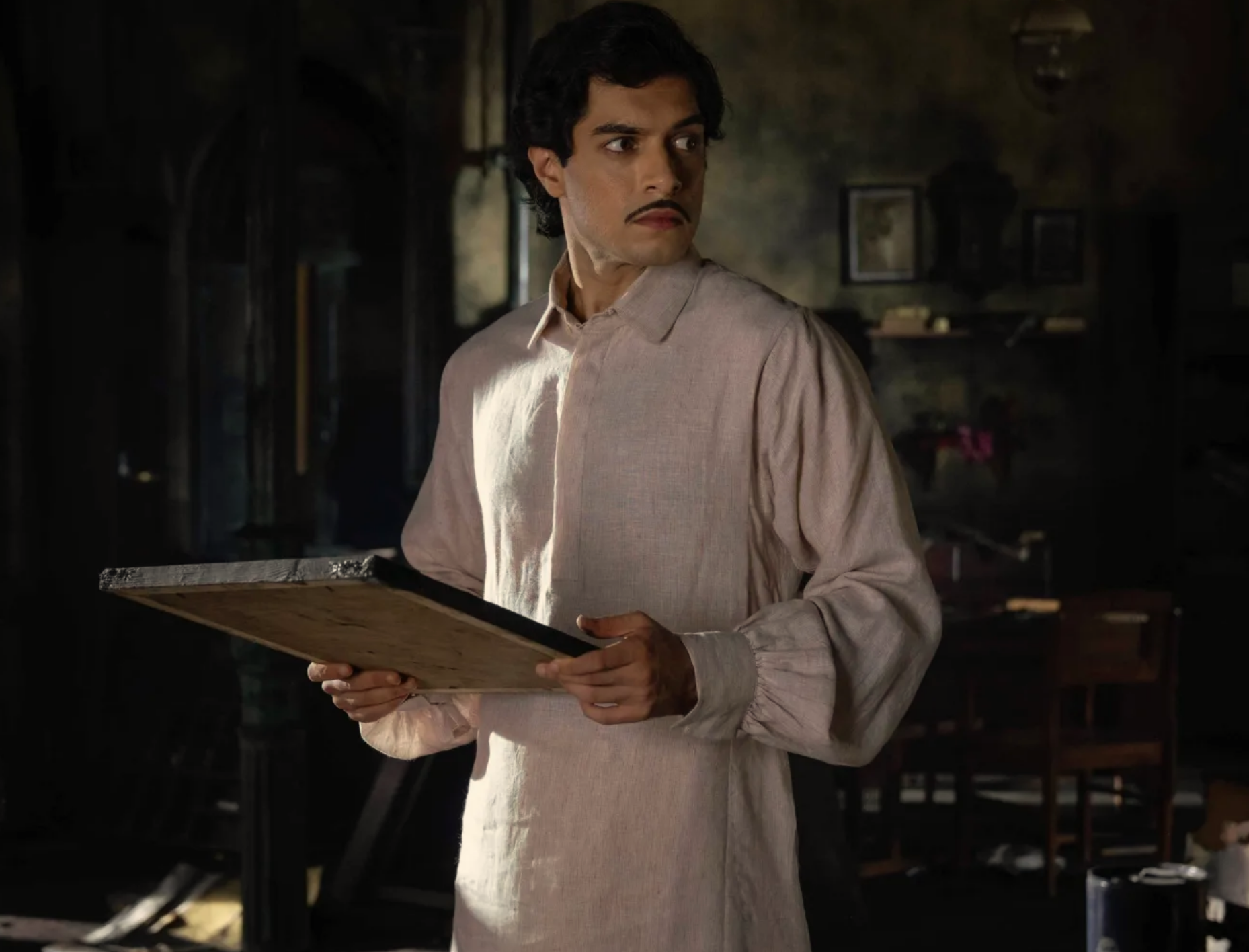
On screen, Maharaj has sincerity, strong performances, and visual polish. Junaid Khan brings restraint; Jaideep Ahlawat communicates menace through stillness and body language; Sharvari adds warmth and fragility. Yet the translation from idea to image feels uneven.
The mise-en-scène is often illustrative rather than interpretive—telling rather than revealing. The camera observes, but seldom interprets. Spaces feel staged rather than lived in, and the rhythm of scenes doesn’t allow tension to breathe.
The film speaks of “the people,” but rarely lets them inhabit the frame. They remain abstract—referred to, not represented. This absence weakens the thematic center: a story about awakening ends up feeling curiously solitary.
Moments of brilliance—glances, silences, subtext in gesture—hint at a deeper film struggling to emerge. But its editing compresses emotion, and its visual choices rarely extend the writing’s thought. The screenplay’s gaps widen when faced with performance and pacing.
Closing Thought
Maharaj shows how even a meaningful story can falter when the architecture of emotion isn’t built as carefully as the argument of plot. The premise had strength; the design didn’t serve it. As McKee reminds us:
“We go to the movies not for messages, but for meaning — a felt sense of life.”
This film gives us the message. The meaning, however, slips quietly through its frames.
— SM
 ScreenScribbles